


"Biofilm" – The Hidden Killer in Water Networks
Stay informed with the latest news, resources, and insights from Takween Plast.

Kenan Alsoufi
CEO - Partnership
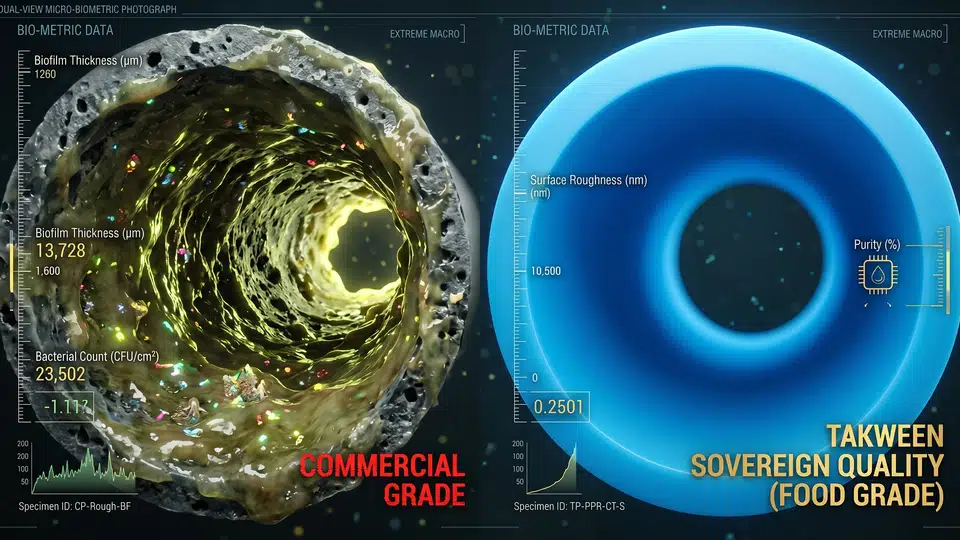
The Interplay Between Hydraulic Design, Material Properties, and Drinking Water Quality in Hot Climates Executive Summary Maintaining drinking water quality from the moment it leaves treatment or desalination plants until it reaches the consumer's tap is a complex engineering challenge. In the Gulf region, where temperatures rise exceptionally, this challenge morphs into a silent crisis known as "Biofilm." This in-depth report investigates the biomechanics and hydraulics of biofilm formation, highlighting common engineering flaws in pipe material selection and the neglect of the "friction coefficient." Furthermore, it showcases the radical solutions provided by advanced polymer technologies, specifically "Takween Plast" products, to ensure the sustainability and safety of water networks.
Article content
1. Biomechanics: What is "Biofilm" and Why is it a Hidden Killer?
Biofilm is not merely simple contamination; it is a complex, living colony. As water flows through pipes, free-floating (planktonic) bacteria attach to the internal surface. Once attached, they secrete a slimy substance known as Extracellular Polymeric Substance (EPS). This matrix acts as a biological shield, protecting the bacteria from disinfectants (like chlorine) and the shear stress of the water flow.
Why is it dangerous?
- Incubator for Pathogens: Biofilm provides an ideal breeding ground for dangerous bacteria such as Legionella and Pseudomonas.
- Free Chlorine Depletion: The biological matrix reacts with and consumes the residual chlorine in the water, leaving the network vulnerable to external contamination.
- Microbiologically Influenced Corrosion (MIC): Certain bacteria at the base of the biofilm secrete acids that cause rapid internal corrosion in metallic pipes.
2. The Critical Role of Hydraulic Design and Friction Coefficient
This is where a fatal flaw often occurs—designing networks without accounting for the micro-dynamics of fluid flow.
A. Internal Surface Roughness
Every pipe has an "absolute roughness," denoted by $\epsilon$ or $k_s$. Metallic pipes (like cast iron or galvanized steel) possess microscopically rough surfaces. These micro-crevices act as safe havens (micro-environments) for bacteria, shielding them from the water's velocity. Conversely, pipes with smooth surfaces drastically reduce the capability for initial bacterial attachment.
B. The Viscous Sublayer
In fluid mechanics, even within turbulent flow, there is a microscopically thin layer of water directly touching the pipe wall where the velocity is near zero. The thickness of this layer is influenced by surface roughness. In rough pipes, this layer is thick enough to comfortably harbor bacteria, allowing them to grow without being washed away.
C. Dead Zones and Flow Velocity
Poor hydraulic design that includes dead ends or oversized pipes leads to a drop in flow velocity $v$ and a lower Reynolds number:
...
When water velocity drops, the "shear stress" on the pipe wall decreases, allowing the biofilm to accumulate and thicken rather than detach and wash away.
...
3. The Gulf Environment: A Catalyst for Bacterial Explosion
The risks multiply in the Gulf region due to two primary factors:
- Temperatures: The temperature of water in tanks and shallow buried pipes typically ranges between 25°C and 35°C—the "golden" and most optimal range for rapid bacterial growth.
- Desalinated Water: Water produced via Reverse Osmosis (RO) is often low in minerals and chemically "aggressive." When it interacts with inferior piping materials, the water chemistry alters, facilitating scaling, which bacteria then use as a foundational base to build biofilm.
4. Risks for Engineers and Urban Planners
Relying on traditional or cheap piping materials to reduce the project's Capital Expenditure (CAPEX) is a dangerous engineering trap:
- Catastrophic Failure in Water Quality Tests: Buildings or districts failing to pass municipal health and safety tests due to recurring bacterial contamination.
- Skyrocketing Maintenance Costs (OPEX): The constant need to pump high doses of chemicals for "Shock Chlorination" or to perform continuous mechanical backwashing.
- Legal and Professional Liability: Causing respiratory or gastrointestinal disease outbreaks among residents or hospital patients due to poor material selection and design.
5. The Radical Solution: Advanced Material Engineering by "Takween Plast"
To eliminate the "hidden killer," intervention must target the root of the problem: the attachment environment. Here, advanced plastic pipes (such as HDPE and UPVC) produced by "Takween Plast" emerge not merely as an alternative, but as an engineering necessity, backed by the following scientific reasons:
- Micro-smoothness: Takween pipes boast an exceptionally low friction coefficient (the $C$ value in the Hazen-Williams equation approaches 150, whereas in aging metallic pipes it can drop to 90). This glass-like surface denies bacteria any anchoring points, making biofilm formation virtually impossible.
- Absolute Chemical Inertness: Unlike metals that oxidize, or poor-quality plastics that degrade in high temperatures and leach organics to feed bacteria, Takween pipes are entirely inert. They do not corrode, remain unaffected by the extreme Gulf heat, and do not react with chlorine.
- Sustainable Hydraulic Efficiency: With zero scaling or biofilm buildup, Takween pipes maintain their effective internal diameter throughout their lifespan. This ensures stable pressure and prevents the sudden formation of dead zones.
Conclusion:
The selection of pipe material and hydraulic design is the primary line of defense in protecting public health. The advanced polymer solutions provided by "Takween Plast" offer engineers and developers hydraulic and biological security that lasts for decades, successfully outperforming the harsh climatic challenges of the region.
Would you like to focus the next research topic on the specific challenges within a particular sector, such as water networks in healthcare facilities (where risks are highest), or should we move on to detailing the impact of aggressive soils on underground infrastructure?
Related Posts
Extreme Thermal Stress in the Gulf
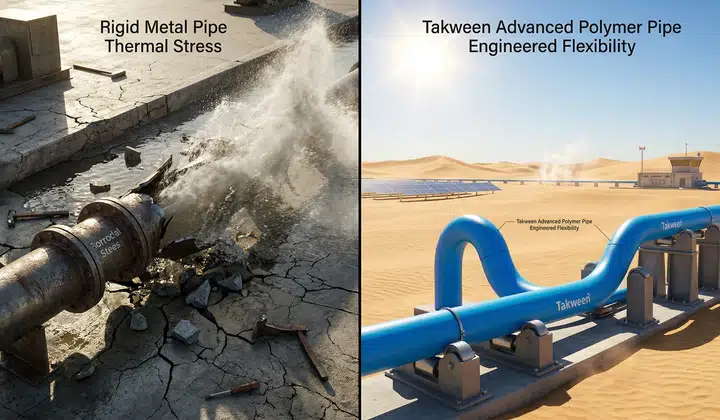
Is Our Infrastructure Melting from the Inside? (Pipe Thermodynamics and the Risks of Silent Collapse) Executive Summary Infrastructure in the Arabian Gulf is subjected to one of the harshest thermal environments on Earth. The issue extends far beyond ambient air temperature; it encompasses direct solar radiation and summer soil temperatures that frequently exceed 60°C. This research investigates the phenomenon of "thermal stress, expansion, and contraction" within piping networks, highlighting fatal structural errors that occur when engineers neglect expansion joints. Furthermore, the paper explores how advanced polymer engineering at "Takween Plast" provides solutions grounded in "structural flexibility" to safely absorb these stresses, ensuring the long-term sustainability of networks and preventing catastrophic bursts.
Read more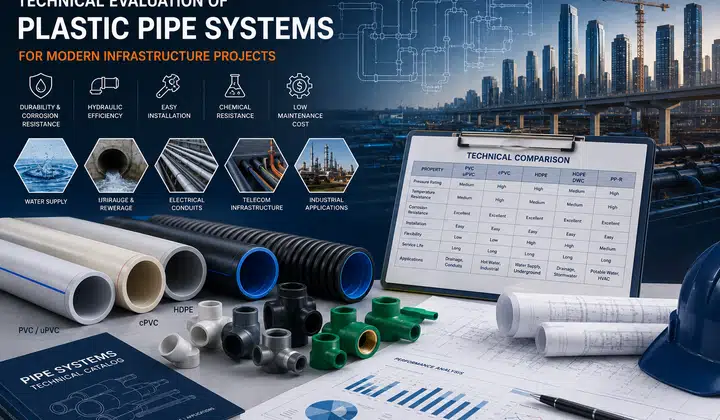
Technical Evaluation of Plastic Pipe Systems for Modern Infrastructure Projects
Plastic pipe systems have become essential in modern infrastructure due to their durability, corrosion resistance, hydraulic efficiency, installation flexibility, and suitability for different engineering applications. This paper reviews the main categories of plastic pipes and fittings used in construction and infrastructure projects, including PVC, uPVC, cPVC, HDPE, HDPE DWC, PP-R, and optical duct systems.
Read more