


Extreme Thermal Stress in the Gulf
Stay informed with the latest news, resources, and insights from Takween Plast.

Yamen Fares
Business Development Manager
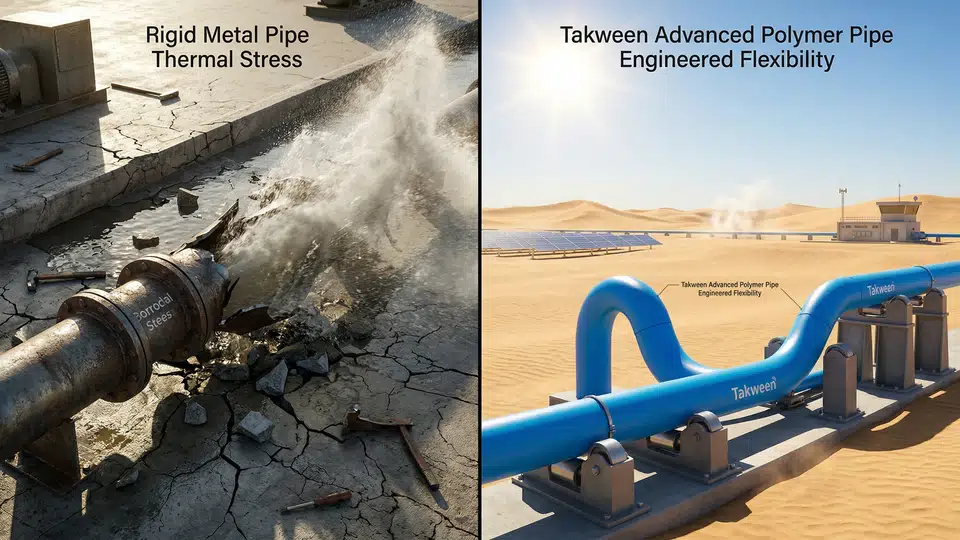
Is Our Infrastructure Melting from the Inside? (Pipe Thermodynamics and the Risks of Silent Collapse) Executive Summary Infrastructure in the Arabian Gulf is subjected to one of the harshest thermal environments on Earth. The issue extends far beyond ambient air temperature; it encompasses direct solar radiation and summer soil temperatures that frequently exceed 60°C. This research investigates the phenomenon of "thermal stress, expansion, and contraction" within piping networks, highlighting fatal structural errors that occur when engineers neglect expansion joints. Furthermore, the paper explores how advanced polymer engineering at "Takween Plast" provides solutions grounded in "structural flexibility" to safely absorb these stresses, ensuring the long-term sustainability of networks and preventing catastrophic bursts.
Article content
1. The Physics of Thermal Expansion: The Hidden Force Tearing Steel Apart
Every engineering material is governed by the laws of linear thermal expansion. As temperature rises, the material's molecules gain kinetic energy and move further apart, resulting in an increase in the pipe's length.
This expansion is calculated using the formula:
(Where: $\Delta L$ is the change in length, $\alpha$ is the coefficient of thermal expansion, $L$ is the original length, and $\Delta T$ is the temperature differential).
The true danger does not lie in the expansion itself, but rather in the "Restraint":
When a pipe is rigidly fixed (e.g., tightly anchored between two walls or under solid asphalt) and prevented from moving naturally as temperatures rise, this suppressed expansion transforms into massive Compressive Stress, measured in thousands of Newtons. This immense force inevitably seeks out the weakest point in the network (typically joints or valves) to release its energy, leading to buckling and eventual rupture.
2. The Extreme Gulf Environment: Much More Than Just "Hot Weather"
Many junior engineers, or those accustomed to colder climates, severely underestimate the Gulf's environmental data:
- Exposed Pipes: Pipes laid on building rooftops are subjected to direct solar radiation (UV and IR). The surface temperature of a black or dark grey pipe can easily reach 75°C, even when the ambient air temperature is only 45°C.
- Buried Pipes: The sandy soil in the Gulf retains heat exceptionally well. Pipes buried in shallow trenches (less than one meter deep) undergo brutal daily cycles of expansion during the day and contraction at night, leading to severe material fatigue over time.
3. The Fatal Structural Flaw: The Absence of an "Expansion Joint" Culture
Long piping networks require precise engineering techniques to accommodate movement. Ignoring these protocols is an engineering disaster waiting to happen:
- Over-restraining: Utilizing rigid, non-slip clamps that prohibit the pipe's natural longitudinal movement.
- Ignoring Expansion Loops: Failing to design U-shaped or Z-shaped directional changes in long pipe runs, which act as "springs" to safely absorb expansion.
- Disregarding Installation Temperature: A pipe might be installed at dawn when the temperature is a cool 20°C. By high noon, the temperature spikes to 50°C. The pipe expands and breaks immediately because the engineer failed to account for the massive 30°C temperature differential ($\Delta T$) prior to testing and anchoring.
4. The Advanced Engineering Solution with "Takween Plast": The Power of Flexibility
A common engineering myth is that metal pipes are superior in hot climates simply because their coefficient of expansion is lower than that of plastics. This is fundamentally incorrect.
The complete equation for thermal stress relies heavily on the "Modulus of Elasticity" (E):
Metallic pipes are extremely rigid (possessing a very high $E$ value). Therefore, even a microscopic amount of restrained expansion generates a destructive force capable of shattering concrete anchors.
This is where Takween’s advanced polymer pipes (HDPE and UPVC) prove their superiority:
- High Flexibility: The modulus of elasticity in Takween's pipes is significantly lower than that of metals. This means they can expand and contract with high flexibility, absorbing thermal shocks without transferring destructive stresses to the joints, fittings, or the surrounding building structure.
- Resistance to Thermal Degradation: Takween products are manufactured with state-of-the-art additives (UV Stabilizers and Anti-oxidants) that prevent the pipe from drying out, becoming brittle, or degrading when exposed to direct sunlight and extreme Gulf heat over decades.
Takween's Guidelines for Safe Installation:
- In Trenches (For Buried Pipes): Takween strongly recommends the "Snaking Technique." Instead of laying the pipe in a perfectly straight line, it is placed with a gentle, continuous 'S' curve within the trench. This extra length comfortably absorbs winter contraction and summer expansion without stressing the welded joints.
- Exposed Installations: Providing contractors with precise engineering tables that dictate the correct spacing for sliding supports and the exact dimensions required for expansion loops, customized for the specific temperature differentials expected at the project site.
Related Posts
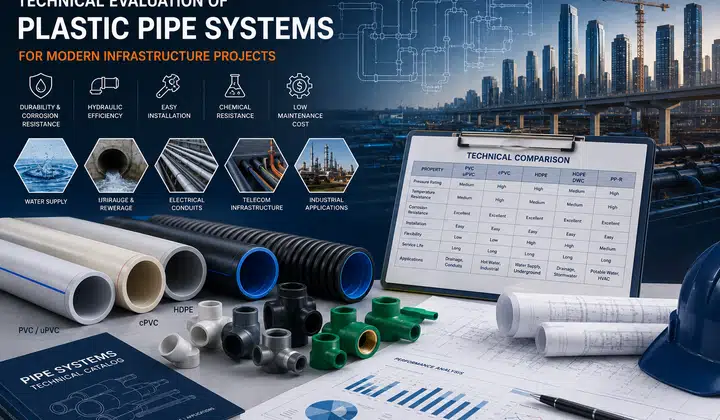
Technical Evaluation of Plastic Pipe Systems for Modern Infrastructure Projects
Plastic pipe systems have become essential in modern infrastructure due to their durability, corrosion resistance, hydraulic efficiency, installation flexibility, and suitability for different engineering applications. This paper reviews the main categories of plastic pipes and fittings used in construction and infrastructure projects, including PVC, uPVC, cPVC, HDPE, HDPE DWC, PP-R, and optical duct systems.
Read more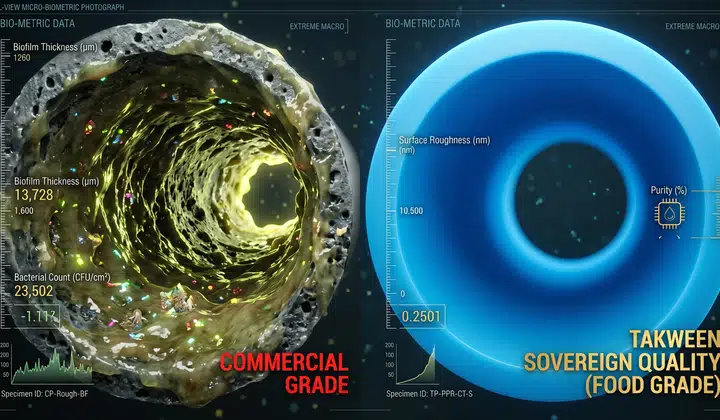
"Biofilm" – The Hidden Killer in Water Networks
The Interplay Between Hydraulic Design, Material Properties, and Drinking Water Quality in Hot Climates Executive Summary Maintaining drinking water quality from the moment it leaves treatment or desalination plants until it reaches the consumer's tap is a complex engineering challenge. In the Gulf region, where temperatures rise exceptionally, this challenge morphs into a silent crisis known as "Biofilm." This in-depth report investigates the biomechanics and hydraulics of biofilm formation, highlighting common engineering flaws in pipe material selection and the neglect of the "friction coefficient." Furthermore, it showcases the radical solutions provided by advanced polymer technologies, specifically "Takween Plast" products, to ensure the sustainability and safety of water networks.
Read more